The Hieronymus Machine
A modern, solid-state reconstruction of a curious piece of 20th-century instrumentation — rebuilt with today's components for study, education, and open experimentation.
Background
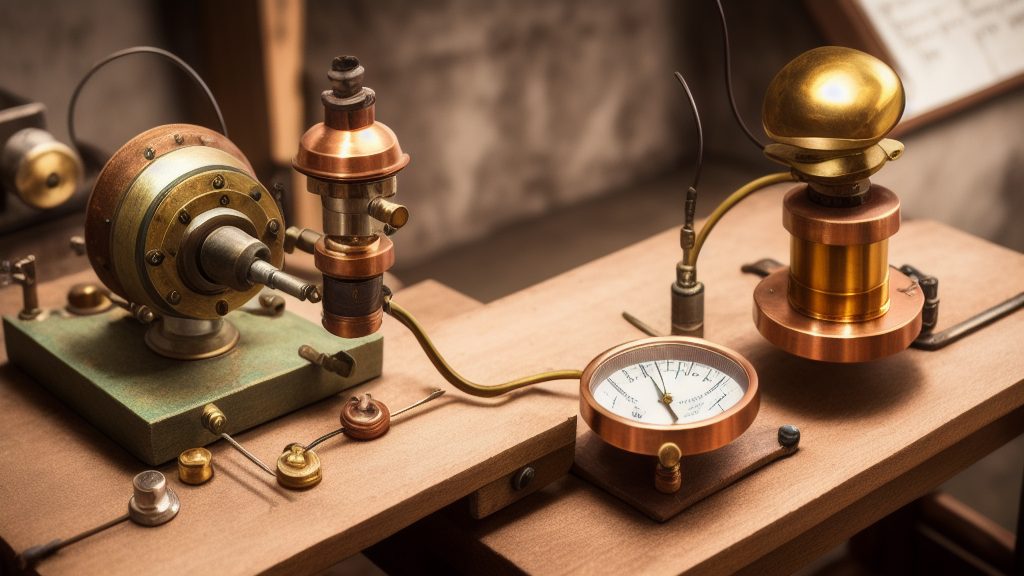
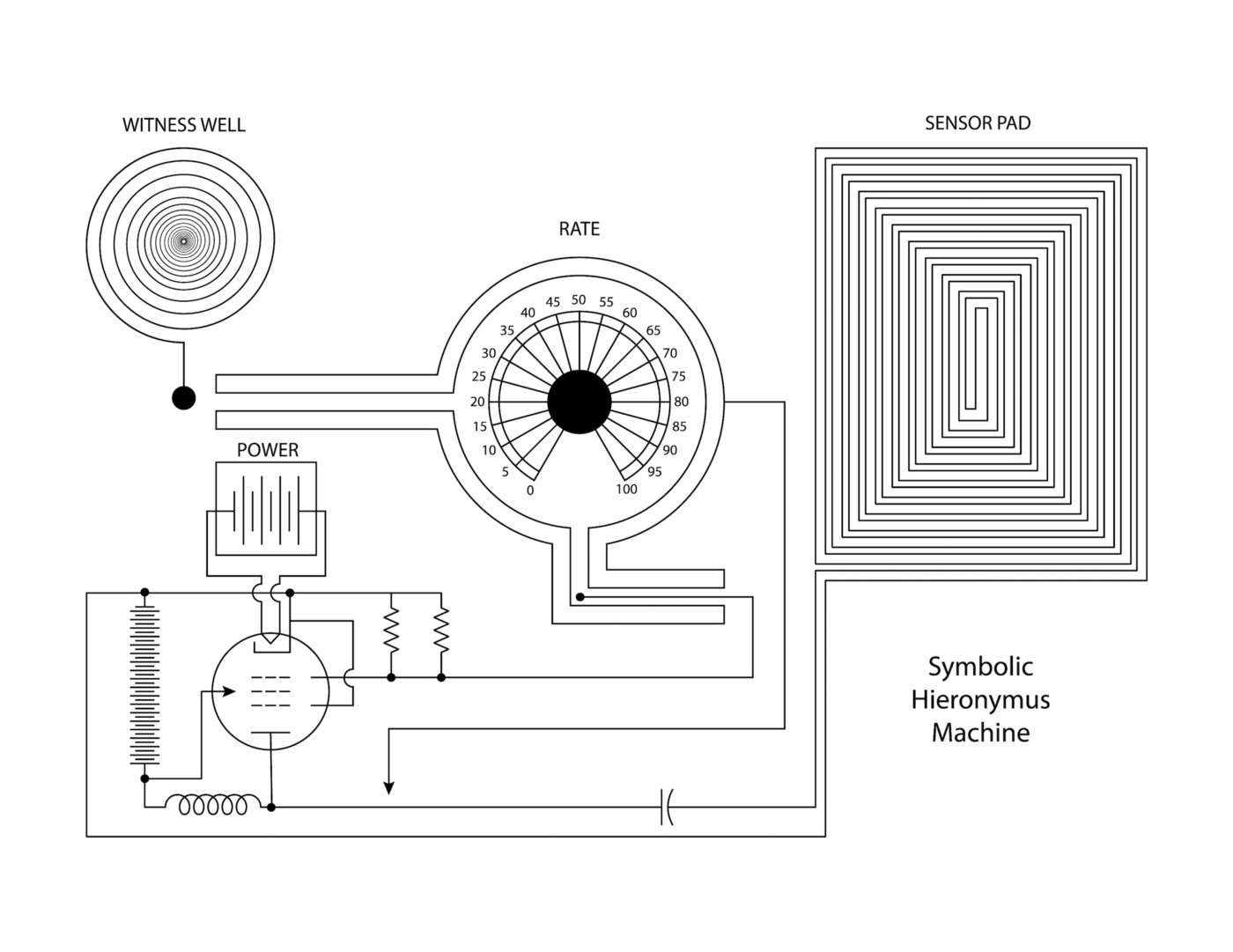
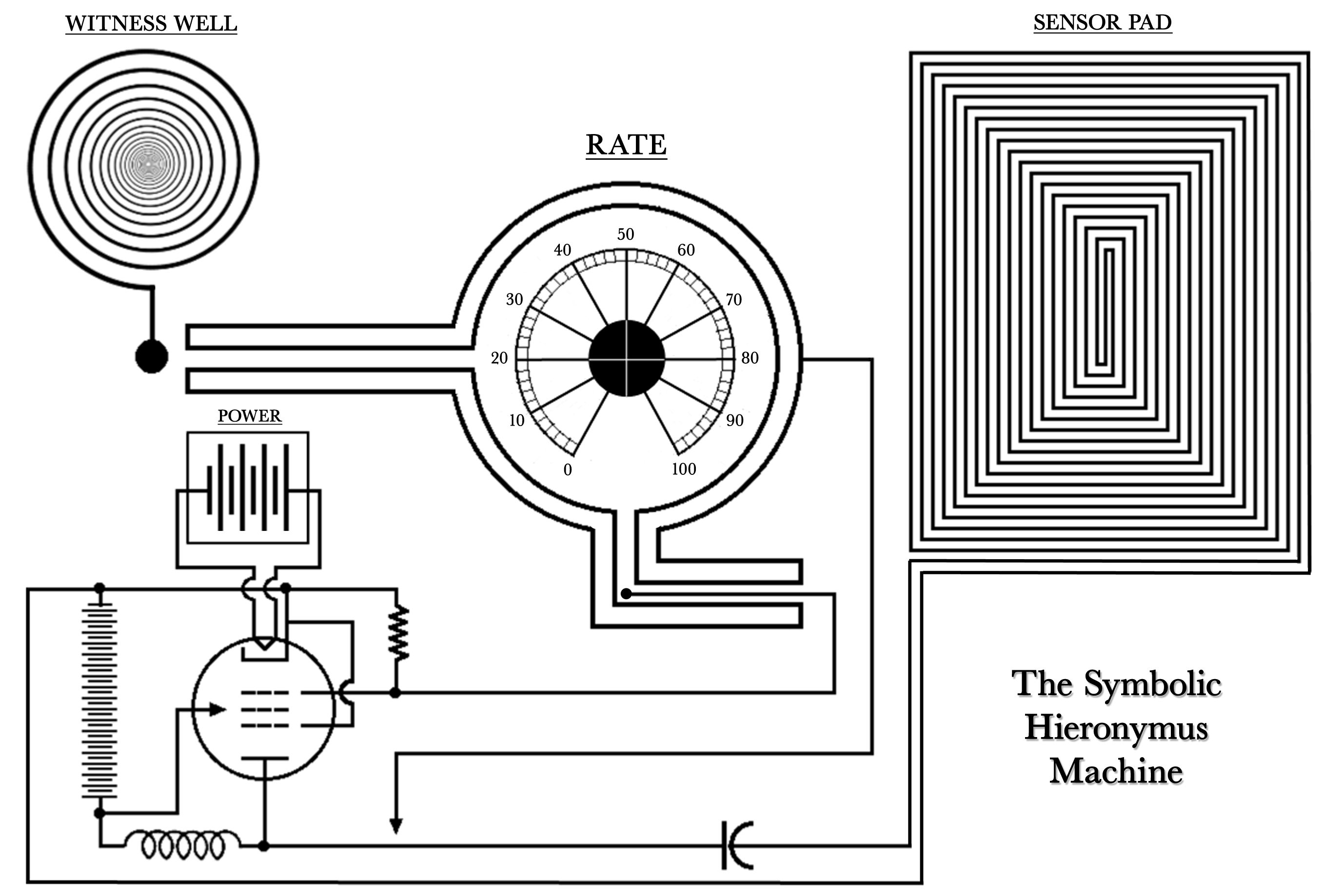
The Hieronymus Machine was patented in 1949 by Thomas Galen Hieronymus (U.S. Patent 2,482,773) and later popularized by science-fiction editor John W. Campbell in the pages of Astounding Science Fiction. The original device combined a "witness" chamber, a tuning ("rate") dial, a prism-and-probe analyzer, and a stroking touch plate. It remains a fascinating artifact in the history of fringe instrumentation.
Our modern reconstruction
Rather than reproduce the fragile vacuum-tube original, our design translates the concept into a clean, solid-state analog that any competent maker can build and study:
- Witness well — a 100 mL Pyrex chamber wound with 22 AWG magnet wire.
- Tuning / rate stage — a 10 kΩ rotary potentiometer with a 1 nF reference capacitor in place of the original prism.
- Amplification — three 2N3904 NPN transistor stages for stable, low-noise solid-state gain.
- Touch plate — a Bakelite sheet with a bifilar coil and a capacitive touch sensor for operator interaction.
- Sensor pad — a spiral pickup, mirroring the original layout.
A complete KiCad schematic and PCB layout (Enhanced_Hieronymus_Machine) accompanies the project, with a parts list sourced from standard suppliers such as DigiKey and Adafruit.
Galvanic skin response: an objective operator interface
The original device relied on a touch ("stick") plate: the operator stroked a surface and reported a subjective change in tactile friction at the tuning point. That cue is unquantified, unrecordable, and highly susceptible to the operator’s own expectation and micro-movement (the well-documented ideomotor effect). We propose replacing—or running in parallel with—that plate with galvanic skin response (GSR), turning a subjective sensation into an instrument-grade electrophysiological signal.
Why GSR is the right modernization
GSR—also called electrodermal activity (EDA) or skin conductance—is a mainstream, validated psychophysiological measurement. Eccrine sweat glands on the fingers and palms are driven almost purely by the sympathetic branch of the autonomic nervous system; as arousal changes, sweat-gland activity changes the skin’s electrical conductance in a way that can be measured, timestamped, and logged. It is the same signal used in biofeedback, polygraphy, and modern wearable stress monitors.
The E-meter is, in engineering terms, a GSR bridge
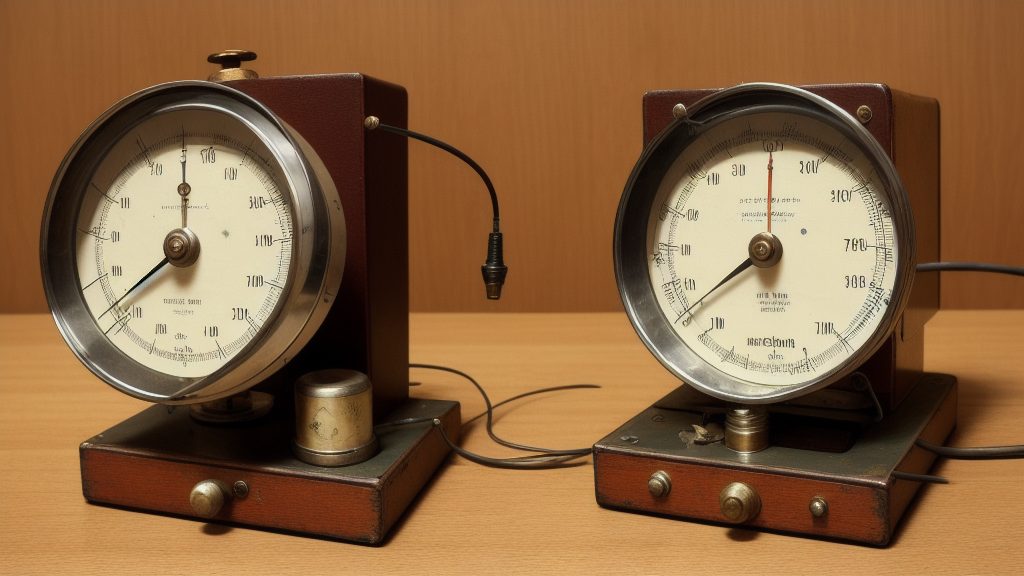
The Dianetics / Scientology "E-meter" is functionally a Wheatstone-bridge ohmmeter that measures skin galvanic resistance between two hand-held electrodes. Volney Mathison’s electropsychometer (U.S. Patents 2,684,670, 1954 and 2,736,313, 1956) and L. Ron Hubbard’s later E-meter (U.S. Patent 3,290,589, 1966) both describe this bridge-based skin-resistance measurement. Because that bridge is a well-characterized, low-voltage, inherently safe implementation of GSR, it is a natural, proven front end to graft onto the original design. (The historical figures can be viewed at the linked patents; the schematic below is our own representation of the generic, public-domain circuit.)
Our implementation
We remove the Bakelite touch plate (or keep it as a secondary channel) and add a two-electrode GSR front end: electrodes → Wheatstone bridge → instrumentation amplifier → ADC → microcontroller with a digital readout and data logging. The excitation is constant-voltage, current-limited to a few microamps, fully isolated and low-voltage—well within accepted biofeedback safety practice. The tuning ("rate") dial and the GSR trace are recorded together, so any claimed correlation becomes a testable, reproducible dataset rather than an unfalsifiable feeling.
Sources
Hieronymus, U.S. Patent 2,482,773 (1949). Mathison electropsychometer, U.S. Patents 2,684,670 and 2,736,313. Hubbard E-meter, U.S. Patent 3,290,589 (1966). Boucsein, W., Electrodermal Activity, 2nd ed., Springer (2012). Society for Psychophysiological Research EDA committee guidelines, SPR / Psychophysiology. Electrodermal activity overview, NIH / PMC.
Engineers wanted
We are actively developing this as a modern, open, well-documented engineering reconstruction, and we are looking for electrical engineers, PCB designers, firmware developers, and makers who want to help build and test it. If historical instrumentation, analog design, and rigorous experimentation excite you, we would love to collaborate.
Email us to get involved or write info@biomedrx.technology